

Black History Month 2022: Courtney Jones-Stevens

(4 min read)
Courtney Jones-Stevens is a Project Management Coach based in the United States. The week, the Multiverse Community sat down with Courtney who talked about this year’s theme of health, wellness, and joy as we celebrate Black History Month in the US.
This year’s BHM theme is Health, Wellness, and Joy - Why do you think this theme is particularly important to celebrate for Black History?
The founding of the United States is deeply rooted in white supremacy and the lack of joy for the descendants of Black enslaved people. Therefore health, wellness, and joy immediately make me think of the stories that I learned from my grandmother growing up -- whose parents were sharecroppers and whose grandparents were enslaved. Therefore it has been great to see health, wellness, and joy for a community of people who have been constantly robbed of that. This is especially true after a really long time of protesting, fighting, and advocacy. Health and wellness are not always categorized with joy, but there is a time to fight, and I don’t know if that always has to be my lived experience. I can have joy too.
With that being said, what is a barrier that comes to mind when you think about Black professionals experiencing health, wellness, and joy while balancing work?
I would say the wage and wealth gap for Black mothers. We know that Black women are routinely caregivers for younger and older generations. Therefore, it’s not only a gender gap or a race gap but it has a lot to do with your status as a caregiver in this country.
You don't know what people are balancing outside of work and I definitely think covid has made a space for us to feel more comfortable to talk about some of these hardships. However, as Black women, we still don't feel that we can share these things without our performance being negatively judged or evaluated. So never being able to shed stereotypes and microaggressions is an added layer to whatever everybody else is experiencing.
So this brings us to the topic of being your authentic self at work. Black professionals can feel as if they cannot be themselves at work. Therefore what are your thoughts on this and what would you advise to apprentices who may be navigating this feeling?
I think this has to do with building your sense of self-worth and self-esteem so that you don’t second guess whether or not you belong in a space. That has been the through-line in conversations with my apprentices. Imposter syndrome is real and seizing a generation of people who are so talented and bright. So navigating this involves taking up space and resisting the inclination to shrink yourself. And if that cannot be done at work, then I always recommend therapy.
Another barrier to health, wellness, and joy is the ability to practice consistent self-care. With such busy schedules and high expectations at work, how do you ensure that this does not get deprioritized in your life? What is your advice to apprentices struggling with this?
A lot of my self-care is rooted in honoring the legacy and sacrifice of people who couldn't do it. My mother and grandmother didn't have the privilege to take the time to intentionally sit back, think, reflect, and be mindful. All of these buzzwords that we have now were built on the backs of their sacrifice. So I think, it would be a disgrace to my grandmother – who had to work in a cotton mill for very low wages – to have the resources to take care of myself and to not use them.
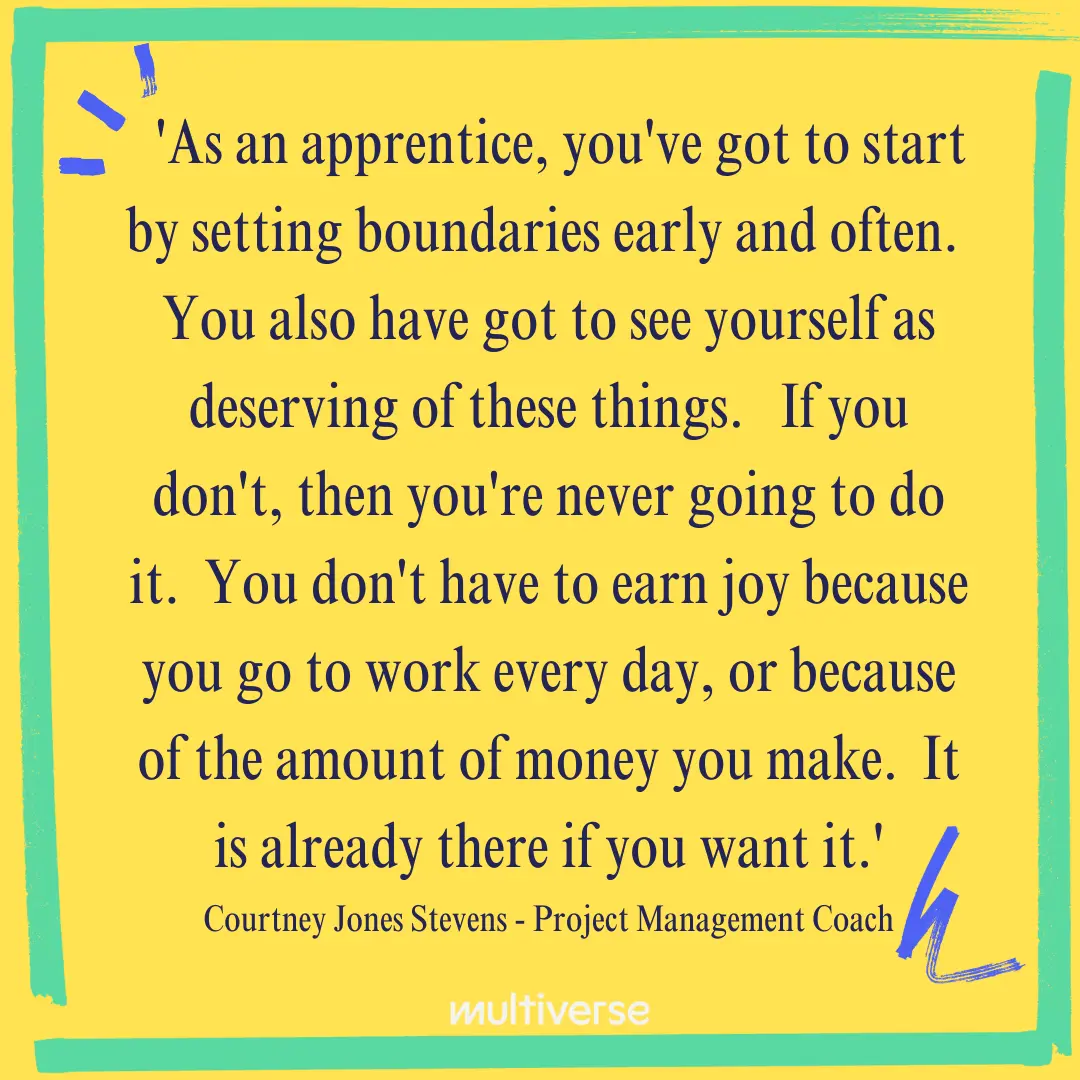
As an apprentice, you've got to start by setting boundaries early and often. You also have got to see yourself as deserving of these things. If you don't, then you're never going to do it. You don't have to earn joy because you go to work every day, or because of the amount of money you make. It is already there if you want it.
Finally, we want to recognize that Black culture and Black heroes should be celebrated consistently. Therefore, how do you celebrate Black history beyond the month of February? How would you encourage us all to do the same?
I believe that we owe it to ourselves to celebrate Black history by making connections to the past and now. I think we've missed the mark on this because we don't know our history and so we're looking for the current version of what has already existed. For example, if we're talking about women's reproductive rights, that means we can look back to Fannie Lou Hamer, who went to the hospital to have uterine fibroids removed, but had a hysterectomy without her permission. There are just so many examples that we have to draw from. We're also seeing so many greats pass along, so there are now spaces open for new legends within and outside of Multiverse to step up and take those places,-- especially in business and tech.
Sign up to 'A Seat at the Table: The Black Experience at Work' here!