

Do you know these two important marketing concepts? by Ollie Bridgman
Ollie Bridgman is a Digital Marketing apprentice at ForwardPMX and is writing for the Community Blogging Team.
'From pouring pints & washing cars, to working with some of the biggest brands on the planet.
Thanks to Multiverse's help, I was able to get a digital marketing apprenticeship within weeks of completing my profile.
I aim to write articles that provide you with actionable takeaways, from professional development & growing confidence, to mental health tips & how to take care of yourself.'
Successfully driving growth and hitting goals is crucial for every business, and as a marketer, optimising is a daily responsibility.
However, as the industry is constantly changing, it’s become ever more difficult to track user data, implement sufficient attribution models and ultimately make the most out of your time & money.
A great way to cut through the noise is to re-familiarise yourself with the staples of marketing.
Let’s start with the interesting concept of incrementality.
Incrementality
I found a great definition of incrementality on Measured.com.
“Incrementality in marketing is the lift or increase in the desired outcome (for example, awareness, web visits, conversions, revenue, profitability) provided by marketing activity."
Incrementality testing and measurement can provide the true incremental contribution of your paid media at the channel, tactic, campaign, or ad set level. Incrementality in marketing is especially needed for channels where ad impressions are difficult to map and measure, such as “walled garden” social channels, including Facebook, Snap and Pinterest, or even TV and direct mail.”
Measuring for incrementality identifies:
- Where to eliminate wasteful spending
- Surface opportunities to scale
- Expand and re-allocate media spend for maximum growth
- Which media investments contribute to business metrics and by how much
The thought behind Incrementality has been around for a long time - many marketers have likely heard the 18th century quote from John Wanamaker:
“Half the money I spend on advertising is wasted; the trouble is I don't know which half.” - John Wanamaker
This has been a struggle for many generations.
If you don’t know where your desired results are coming from, how can you optimise? How can you rationally scale a business if you don’t know where to eliminate waste and where to increase spend?
Fast forward a few hundred years from John’s time and us marketers now have digital platforms throwing truck loads of data in our faces.
However, we’re still seeing the same problems.
With so much data coming from multiple marketing channels, how do we know if these campaigns pushed a sale, or whether the user was already going to make a purchase?
So, how do we measure incrementality?
Again, I’ll let Measured.com explain this, as I found their article very useful. (And I don’t want to pretend I’m an incrementality expert)
“The most accurate way to measure incrementality of media is through testing and experimentation. To measure incrementality, audiences are randomly segmented into test and control groups. The difference in conversion rates between the two groups demonstrates the marginal incremental contribution of that media channel.
Incrementality measurement can vary in complexity from a simple holdout test as described above to multivariate experiments so elaborate they require the expertise of a trained data scientist. But, when carefully designed and cleanly executed, controlled experiments can utilise data from an unlimited number of sources to reveal the incremental impact of just about anything marketers want to test – on any outcome that can be measured.”
Understanding this concept is great, but actually implementing it to your business is crucial to thriving in the modern environment.
The See, Think, Do, Care Framework
This is a very interesting framework which I learnt of only recently. This, in my view, is a much needed update to the marketing funnel when it comes to multi-channel digital marketing. It provides an in-depth understanding of how users behave online, as well as how you should interact with and market to your audience.
“The See, Think, Do, Care framework" is a digital marketing framework created by Avinash Kaushik, the co-founder of Market Movie Inc and the Digital Marketing Evangelist for Google. It helps marketers understand the consumer decision-making process through a multi-channel marketing approach.”
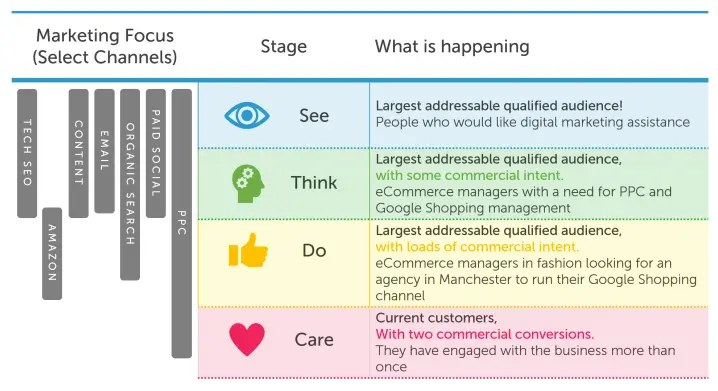
Once you begin understanding this framework and the journey users will go through, you can start to understand the thoughts & desires of your audience, and think about which channel or combination of channels will be the most effective for your goals.
Let’s go through the possible strategy you could build using this framework.
Say your latest marketing client is a music shop, with a focus on selling both products (instruments & parts) and services (repairs tunings and lessons).
See
Remember, the See stage is at the top of the buyer journey and contains the largest addressable and qualified audience. Who are these people?
They aren’t in the buying stage yet, but they know they’re interested in music products/services. You would likely want to run high-quality:
- Content
- SEO
- Paid Social
- PPC Word of mouth
Think
Still not in the buying stage just yet, but we still have a large interested audience with some commercial intent. You don’t want to start selling too early; continue nurturing your audience.
These users now know they’re interested in buying a bass guitar and a piano.
They probably desire:
- Buying the instrument
- Tuning services
- Lessons
- Cleaning equipment
- Strings
- Insurance
You could start writing articles about these topics, optimising the SEO and using paid campaigns to drive traffic to your site. Like I said, nurture the interest the user shows and they’ll start to feel like you're the business they want to associate with.
Do
Again, the largest addressable and qualified audience, but with loads of commercial intent. They are much further down the buyer funnel, know what they’re looking for and have a greater intent to buy.
The customer understands and knows the brands and products they like, they’ve done their research and are ready to buy.
Your audience has narrowed down their options to brand and products, maybe down to two or three choices and are now interested in a small range of qualifying factors before making the purchase. These might include:
- Price
- Availability
- Delivery options
- Service reviews
Social proof, reviews, word of mouth and great customer service will help you convert the interested person into a customer.
Care
Finally, the care group. These are buyers who have purchased off you at least twice before. You must nurture your loyal audience and continue to serve them well, maintaining healthy relationships and upselling along the way.
You’ve done the hard work, now it’s time to think about how you can:
- Get repeat business
- Turn the customer into an advocate
- Gain positive reviews
As we know, social proof is a powerful force.
When you buy something online, how many reviews do you look at? Do you look for a product/service description? Check there is a warranty? Have your friends/family/colleagues recommended the business to you?
Don’t let the end of this article be the end of your curiosity - these are two great concepts to understand and even better ones to implement to your professional life.
I’ll leave a few great websites on digital marketing below.
If you'd like to write an article to be posted on the Multiverse Community Hub, please fill out this form and a member of the team will be in touch.