

SWE EPA: AM1 Work-Based Project and Q&A Overview | by Esgrid Sikahall
You look like you have been wondering about the EPA. If that’s you and you haven’t read the EPA introduction article, head over there first since it is the best place to start! It will help you understand how the two parts of the EPA fit together.
This article is a two-part one-stop guide for the Assessment Method 1 or AM1. We’ll focus on the two parts of the AM1:
- A Work-Based Project alongside a written report based on it.
- A 1-hour Q&A based on the Work-Based Project report.
In this part of the article, we’ll focus on an overview of the Work-Based Project, the report you’ll write about it, and the 1-hour Q&A. In the next part, we’ll give you a detailed structure for your Work-Based Project report.
Preliminary Considerations About AM1
The AM1 of your EPA is a two-part assessment and both parts are assessed. So, unlike AM2 where only the Professional Discussion is assessed, AM1 assesses both the Work-Based Project report and the associated 1-hour Q&A about the Work-Based Project.
The purpose of both parts is to show that you have met the relevant Knowledge, Skills, and Behaviours or KSBs in your Work-Based Project. The KSBs are the DNA of your Software Engineering L4 Apprenticeship and they underpin both AM2 and AM1.
The apprenticeship standard contains the list of KSBs and in the apprenticeship assessment plan, you can find which KSBs are tackled in AM1 and AM2. Below we’ll focus on the KSBs you need to tackle specifically for AM1. The sources of this article are the assessment plan itself and guidance from Accelerate People, the End Point Assessment Organisation (EPAO) Multiverse partners with.
AM1 Part 1: Work-Based Project
The aim of your Work-Based Project is to engage in the end-to-end SDLC (Software Development Life Cycle). With the SDLC in mind, you should research and develop a software solution that meets the requirements of a particular problem your company is tackling for a particular stakeholder.
Your employer - your manager - will ensure that this project has real business value and Accelerate People will ensure that the project meets all the KSBs assessed in AM1.
How to Identify a Suitable Work-Based Project?
Great question! Accelerate People give some guidance about what a suitable project might look like. This can help you and your manager find a project that adds business value and which covers all the necessary KSBs. If you’re wondering “which KSBs?” you’ll have to wait for the second part of this article - we’ll get there soon though!
Key things to consider to identify a suitable Work-Based Project:
- Is this project work-based? Think of an idea or opportunity, a specific business problem, or a recurring issue in your company or team.
- Does this project add business value?
- Is the task achievable in terms of time and resources? You have 9 weeks to complete your project and write the report.
- Does the project meet all the necessary KSBs?
You can always iterate over the above list: you could identify something that could be a suitable Work-Based Project if amended, added to, or reduced (if too long or ambitious). The key here is to have an achievable, KSB- meeting, and business-value adding Work-Based Project.
When to Identify a Suitable Work-Based Project?
As mentioned in the EPA intro article, you should submit a title and a summary of the Work-Based Project at Gateway. Gateway is thus a useful milestone to have in mind from your second Progress Review onwards.
Your second Progress Review will be close to the middle of your apprenticeship. From then onwards, you should focus on finishing your Portfolio and begin to think about suitable Work-Based Projects.
Between your second and third Progress Reviews, the third being your final Progress Review, you should aim at finding a suitable Work-Based Project and writing a draft of your title and summary of your Work-Based Project.
Your last Progress Review is a good opportunity to clarify the last details for the title and 500-word summary you’ll be submitting at Gateway.
Once this has been identified and you and your manager, with the support of your coach, are happy about it, you need to concretise the proposal with a title and a 500-word summary, which you’ll submit at Gateway.
Prepare the Title and the 500-Word Summary for Gateway
The 500-word summary should contain:
- The customer specification
- An outline of the plan including implementation steps and timescales.
- The date the written report will be submitted to Accelerate People.
Accelerate People use the summary to ratify that this project can tackle the necessary KSBs for AM1.
Your journey, at this stage, looks like this flow diagram:
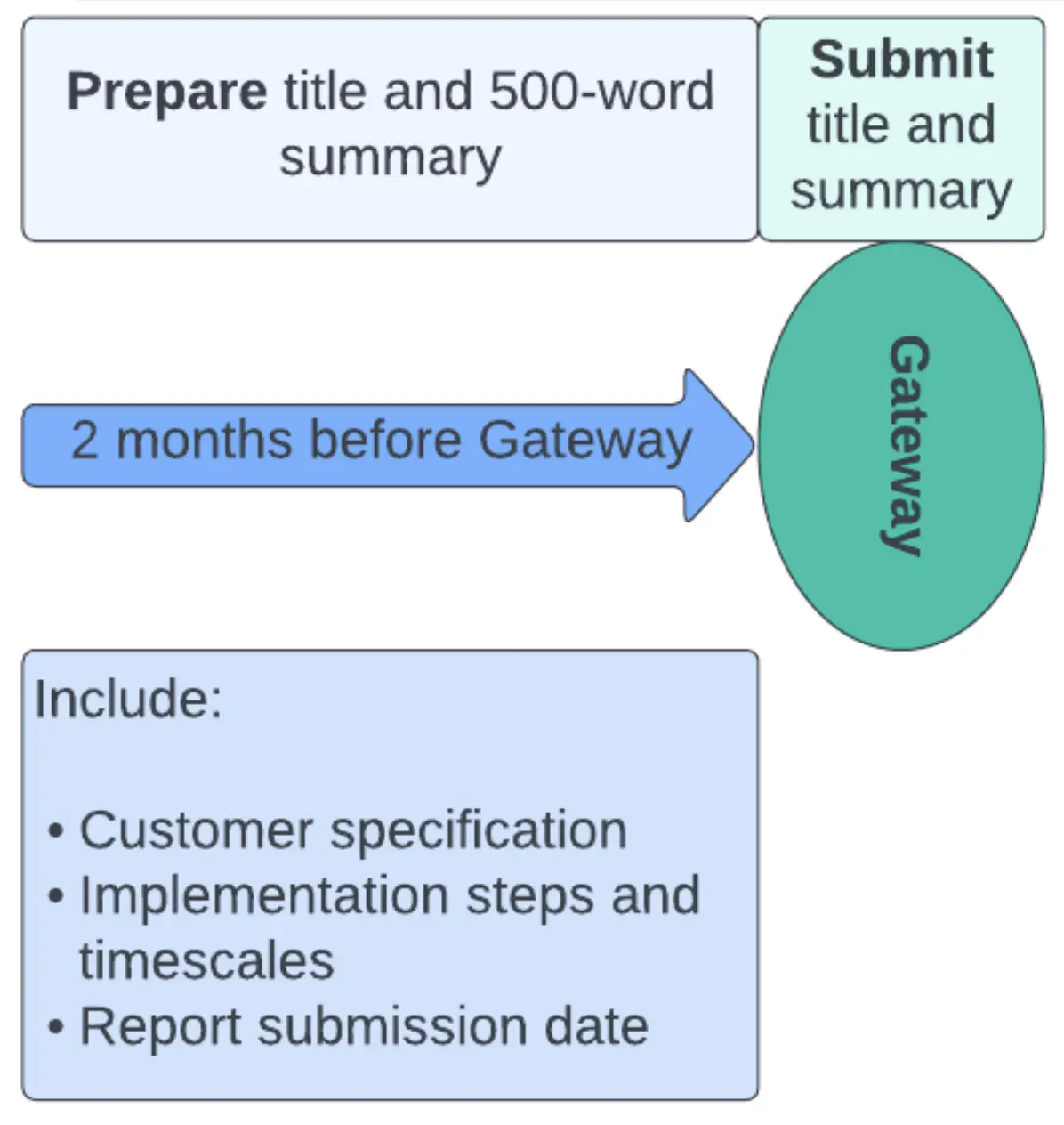
The 2 months in the arrow just show the approximate distance between your last Progress Review and Gateway. As explained above, before your last Progress Review, you should’ve already found and agreed on your Work-Based Project.
Remember that it is your responsibility to be vocal about the importance and scope of the Work-Based Project, especially with your manager. Your coach will support you in communicating this and will bring it up with your manager at appropriate times, but you are the one who is in constant communication with your manager. You are best placed to emphasise the importance of the Work-Based Project and the scope it needs to have.
Work-Based Project After Gateway
The timescale for you to complete your project is 9 weeks after Gateway. You normally would take 7 weeks to do the project and 2 weeks to write the report.
Just like your Portfolio of evidence, you should produce a written report for your Work-Based Project. Unlike your Portfolio, however, this report is assessed. It is a 4500-word report with a margin of 10% - between 4050 and 4950 words - which should take you around 2 weeks to complete. Make sure you keep yourself within the margins! Anything beyond them will be an automatic fail according to Accelerate People’s guidance.
The second part of this article will give you ample guidance on how to structure your report and extra advice on what your Work-Based Project should involve.
Once you have completed your project and written your report, you should submit it - remember that the submission date was set in your 500-word summary. Having gone through the Gateway portal and climbed the Work-Based Project mountain, there’s only one thing left: the 1-hour Q&A. Before moving to it, however, look how far you’ve come:
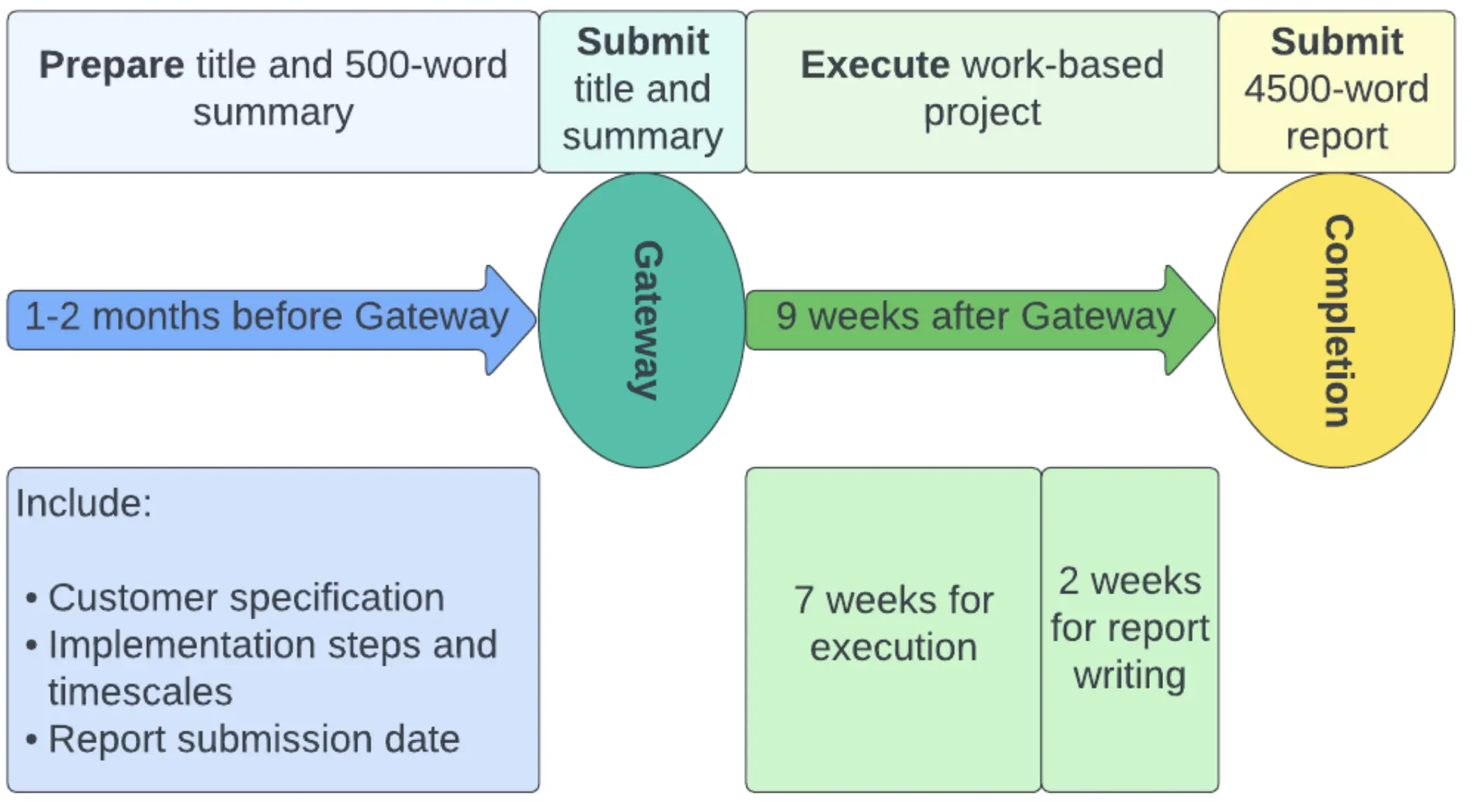
At this point, you have completed the first assessed component of AM1!
AM1 Part 2: 1-Hour Q&A
The second assessed part of the AM1 is the 1-hour Q&A based on your written report. This 1-hour session will happen at least 10 working days after you have submitted your report, on the same day as the 1-hour Professional Discussion underpinned by the Portfolio. You’ll have at least 10 days, usually longer, to prepare for it - studying your report and making sure you know how each of the KSBs is displayed in the specific parts of your report.
The idea behind the 1-hour Q&A is to assess KSBs that would take a longer period of time to observe - think behaviours - and KSBs that are unrelated to each other but that still need assessment. Also, the questioning should give you a chance to go into more depth, beyond what you recorded in your written report.
Think of this session as a time to clarify, expand, add, enrich, rejoice, and discuss the work you recorded in your report.
Q&A Structure
The session will be structured in the following way:
- Welcome & introductions - here you should be told that the session will be recorded.
- Photo identity check, technology-suitability check, and fit to continue check - here you must ensure that you remind the assessor if you need any additional support. Additional support requests should be sent to Accelerate People before the date of the Q&A (the time window between submitting your report and the Q&A is ideal for informing Accelerate People).
- Overview and structure of the session - here the goal and structure of the Q&A should be explained.
- Introduction to the Work-Based Project and why it was chosen - here you can show how and why you chose the project; think about how your project met the KSBs, provided business value, and was achievable in the given time.
- Structured questioning - you’ll get asked at least 12 questions, seeking to understand how the project met the KSBs and added business value. Remember here to show that you understand the SDLC holistically by connecting the dots at every stage of the SDLC.
Top tips:
- Make sure you have a suitable internet connection, camera, headset, and microphone.
- Make sure you locate yourself in a space where you can express yourself confidently, with no interruptions.
- Remember that nobody knows more about this project than you do.
- Practise answering questions on your Work-Based Project. Ask colleagues, fellow apprentices, and family members to have a look at your report and ask you questions about it.
- Practise the setup you’ll use for the Q&A. Open the application (Microsoft Teams for example), locate it on the screen as you want it, and close all other windows (of PDFs, browser windows, or any other app, etc.) except your report - you should be able to search it and refer to it quickly. You can also use a notetaking application like Microsoft Word, Notes, or Pages - the screen will be shared so the assessor can see what you’re doing and seeing.
- Have an empty desk - no notebooks, mobile devices, posters, textbooks, or anything else that could be considered an aid. The only aid you should have is the digital copy of your report.
The completed journey, once you’ve finished the Q&A session, looks as follows:

What an incredible ride you’ve had! Head over to the second part of this article to see a detailed description of the Work-Based Project structure.
If you need to refresh your memory about how the AM1 fits within your whole EPA, head over to the very end of the EPA introduction article to see the timeline again.
From the team of coaches, we wish you all the best in your Work-Based Project and in your Q&A. Be sure that we will support you throughout your journey!
Make sure to check out the whole SWE EPA series:
- SWE EPA: An Introduction
- SWE EPA: AM2 Professional Discussion & Portfolio Overview
- SWE EPA: AM2 Portfolio Structure
- SWE EPA: AM1 Work-Based Project and Q&A Overview
- SWE EPA: AM1 Work-Based Project Report Structure
Esgrid Sikahall is a Software Engineering coach at Multiverse.